


UGC Videos: The Complete Guide 2026
UGC videos have become the most effective advertising format in recent years: content shot by real people, on smartphones, that sells more than a glossy commercial because it feels like a recommendation from friends, not an advertisement. This guide covers everything : what they are, why they work, what formats exist, where to use them, how much they cost, how to write a brief, how to choose creators, and how to measure results. It’s designed for both companies looking to get started and those who want to become UGC creators.

What you’ll find in this guide
- What are UGC videos
- Why they work
- Advantages and disadvantages
- UGC vs influencer vs spot
- Types and formats
- 20 ready-to-use ideas
- Where to use
- Most popular sectors Suitable for:
- Which products work best?
- Anatomy of an effective video:
- Who is the creator? UGC:
- Find and choose the creator
- UGC from real customers (organic)
- The perfect brief
- Review feedback
- How much Cost:
- How to Measure Results:
- Rights, Contracts, and Regulations:
- Common Mistakes:
- How to Become a Creator UGC
- Trends and Future 2026
- Examples and Case Studies
- From Brief to Delivery
- Integrating UGC into Strategy
- 7-Step Checklist
- Getting Started with UGC House
- UGC Glossary
- Questions Frequently asked questions
1. What are UGC videos?
UGC is an acronym for “user-generated content.” A UGC video is a video created by an ordinary person—not an advertising agency or a television studio—that shows, reviews, or uses a product or service in a natural way, usually shot vertically with a smartphone and intended for social media.
The keyword is authenticity. A UGC video doesn’t look like an advertisement: it looks like a friend’s advice, a video of someone who just tried a cream, or the story of someone who solved a problem with a certain product. It’s precisely this “not looking like an advertisement” that makes it so powerful.
“True” UGC video vs. UGC as a production style
Today, the term “UGC video” refers to two different things, and it’s important to distinguish between them:
- UGC spontaneous (organic): is content that a real client publishes on their own initiative, without any agreement or compensation. It’s valuable but uncontrollable: you can’t decide when it arrives, what it says, or how it’s made.
- UGC commissioned (professional UGC): videos shot by creator UGC, specialized people who produce authentic-looking content at the brand’s request, following a brief. These are the videos that companies use in ads and on product pages. These are the ones most often referred to by those searching for “UGC videos.”
In other words: the style is that of spontaneous content (smartphone, natural light, conversational tone), but the production is professional and manageable. You get the best of both worlds: the authenticity of word of mouth and control of the advertising message.
Typical characteristics of a UGC video
- Aspect ratio: vertical 9:16 (TikTok, Reels, Shorts) or 1:1 square for the feed;
- Short duration: typically 15 to 60 seconds;
- Shot with smartphone; natural light or ring light;
- Person speaking in the first person while looking into the camera;
- Conversational tone, no advertising language;
- Focus on the product demonstration (use, results, before/after);
- Often includes subtitles, on-screen text, and trending music.
UGC Video: Meaning and Related Terms
You’ll hear many different ways to say more or less the same thing. Here are the main ones, so you don’t get confused:
- User-Generated Content — the literal translation of UGC;
- Video Creator / Content Creator — UGC created on commission by professionals;
- Authentic videos / Spontaneous content — style-related;
- UGC ads — UGC videos used as ads;
- Video Reviews / Video Testimonials — a widely used subset.
When we say “UGC videos” in this guide, we primarily mean authentic-looking content created by creators for brands: the marketing standard today.
A Brief History: How UGC Became Central
The idea of leveraging customer content is as old as word of mouth. But it was with the explosion of TikTok and Reels that video UGC became the dominant format: users began to prefer raw, authentic content over glossy advertising, and algorithms rewarded precisely that type of video. From there, a new figure was born, the creator UGC, and an entire market of “authentic on-demand” content production. Today, companies aren’t asking themselves whether to use UGC, but how much to scale it.
Why video (and not just photos)
There’s also photographic UGC, useful for product pages and social media. But video has something more: it shows the product in action, conveys voice, tone, and emotion, and holds attention much longer. Above all, it’s the format that platforms push the most. That’s why, when it comes to performance and ads, “UGC” almost always means video: that’s where the greatest return is concentrated.
2. Why UGC Videos Work (and the Data Confirms It)
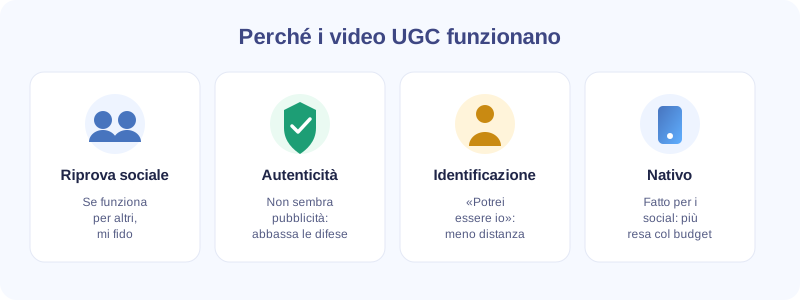
The reason UGC videos convert so well isn’t a fad: it’s rooted in the way we make purchasing decisions. Here are the four main mechanisms.
1. Social Proof
Before buying, we tend to look at what others do and say. A video in which someone “like us” uses the product and speaks highly of it activates social proof: if it works for them, it will work for me too. It’s the same principle as reviews, but in video format and therefore much more convincing.
2. Perceived Authenticity
The average social media user has developed “advertising blindness”: they recognize and ignore ads in a matter of seconds. UGC content, on the other hand, doesn’t trigger this alarm. It looks like organic content, is watched longer, and lowers the viewer’s defenses.
3. Identification
Seeing a normal person—not an unattainable role model—increases identification. The viewer thinks, “That could be me,” and this shortens the distance between desire and purchase.
4. Native for platforms
TikTok, Instagram, and YouTube reward content that “feels like it’s made for them.” A vertical, dynamic, and spoken UGC video is exactly the format that algorithms push and that users are accustomed to consuming, so it gets more views for the same budget.
5. Storytelling and emotion
People don’t buy products, they buy stories and solutions to a perceived problem. A UGC video that starts with a short story (“I was tired of…”, “I couldn’t…”) triggers emotion, and emotion is what drives decisions. This is why a good narrative hook encompasses more than a thousand technical characteristics: it draws the viewer “into” a situation they can identify with.
What we observe in the numbers
Beyond the principles, there are recurring trends that campaign managers continually notice:
- People trust other users’ content much more than direct brand communication: trust is the true driver of conversion.
- Video is the format that generates the most engagement on social media, and the short vertical is the one with the strongest growth.
- In performance campaigns, UGC creatives tend to show higher hook rates and become “tired” more slowly, because so many variations can be produced.
- The majority of users watch videos without audio: this is why subtitles and on-screen text are not optional.
The point is not the single number (which varies by industry and period), but the constant direction: authenticity + video + native = lower cost per result.
Advantages and disadvantages of UGC videos
To make an informed choice, here’s an honest overview of the pros and cons.
Advantages
- Affordable cost compared to established commercials and influencers;
- Authenticity that converts and eliminates “advertising blindness”;
- Scalability: many variants for testing and scaling;
- Your own content, reusable across multiple channels;
- Production speed compared to a traditional campaign;
- Native for algorithms: more yield for the same budget.
Disadvantages (and how to manage them)
- Variable quality If creators are not selected → rely on validated profiles;
- Requires method: testing is needed, “a video” is not enough → establish a process;
- Management of briefs and rights → use clear templates and contracts (or a platform);
- Coordination with multiple creators → better: a single briefing→delivery flow;
- It’s not magic: if the product/offer doesn’t hold up, UGC won’t save them.
3. UGC video vs. influencer marketing vs. traditional advertising
These are three different and often confused things. The key difference: with influencer marketing, you pay primarily for a person’s audience; with UGC videos, you pay for content (which you then use wherever you want); With the traditional spot, you pay for a high-end production .
| Appearance | UGC Video | Influencer Marketing | Traditional Commercial |
|---|---|---|---|
| What You Pay | The Content | The Creator’s Audience | The Production |
| Average Cost | Low / Medium | Medium / High | High / Very High |
| Where Uses | Everywhere (ads, website, email, etc.) | On the influencer’s profile | TV, ads, website |
| Authenticity | Very high | High | Low |
| Message control | High (follow the brief) | Medium | Total |
| Scalability | Very high (many variants) | Low | Low |
| Advertising rights | Included/negotiable | To be negotiated | Included |
Standard — Manage your project: Write the brief, choose the creator and manage your project on the platform. Premium — Fully managed: UGC House provides project consulting, writes the scripts and shortlists creators for you. You make the final choice of who produces your videos. Standard: 99 / 119 / 139 €. Premium: 149 / 169 / 189 € (15 / 30 / 60 s; VAT excluded).
In practice, they are not mutually exclusive: many companies use UGC videos as fuel for Ads (Meta and TikTok Ads), reserving influencers for awareness campaigns and commercials for more important brand opportunities. For those who need to sell online on a controlled budget, UGC is almost always the most effective starting point.
When to choose what
- Choose UGC videos if you want to sell online, test creatives, fill ads and channels with credible content at an affordable cost, and have your own content to reuse everywhere.
- Choose an influencer if your goal is to build awareness among a specific audience and you need their “face” and community to build immediate credibility.
- Choose a traditional commercial if you have a major launch, a high budget, and want a premium brand image on channels like TV or large campaigns.
The most common sequence today: start with UGC to validate messages and creative with real data, and only then invest in more expensive formats on messages that have already proven to work.
4. Types and Formats of UGC Videos
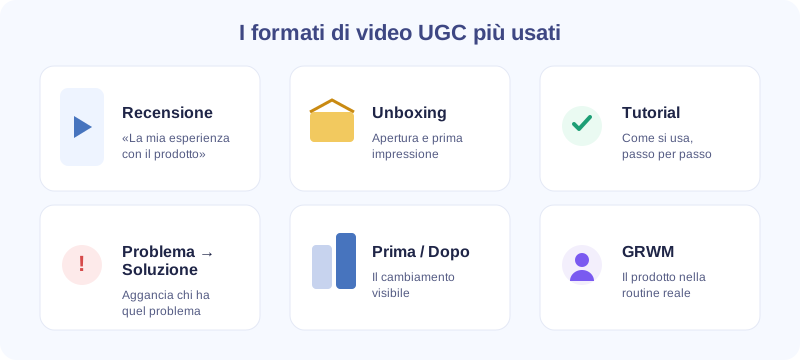
“UGC Video” isn’t a single format: it’s a family. Knowing the formats helps you request the right content for your goal. Here are the main ones.
Review / Testimonial
The creator shares his experience with the product: what he was looking for, how he used it, and the results he achieved. It’s the most versatile format and suitable for almost any industry.
Unboxing
Opening the package and the first impression. It works great for e-commerce, thoughtful packaging, gift products, and to convey the feeling “it’s coming to you too.”
Tutorial / How-to
Shows how to use the product step by step. Ideal for cosmetics, supplements, tech, and household products: reduces pre-purchase doubts and support requests.
Problem → Solution
It starts with a viewer’s real problem and presents the product as a solution. It’s one of the best-performing ad formats because it immediately engages those with that problem.
Before/After and Demonstration of Results
Shows concrete change. Extremely powerful where the result is visible (beauty, fitness, cleansing, skincare). Please note platform rules regarding claims and “before/after” statements.
“Get Ready With Me” and day-in-the-life
The product is inserted into a real-life moment (the morning routine, a typical day). It conveys a lifestyle and works very well for lifestyle, fashion, food, and beauty.
Trend / Native Format
The product rides a current audio trend or format. It has the highest affinity with the algorithm, but a shorter lifespan: it must be produced quickly while the trend is hot.
“Real Customer” Testimonial
A more sober version of the review: the creator interprets the typical customer and describes their experience as if speaking to a friend. It works very well in sectors that require a lot of trust (health, baby, finance). Example hook: “I was skeptical, I’ll tell you right away. Then this thing happened…”
Founder / Brand Story
The founder (or a creator who plays the founder) explains why the product was created. It creates an emotional connection and differentiates the brand. Excellent for awareness campaigns and “about us” pages. Example hook: “I created this product because I couldn’t find anything that…”
Comparison (vs. alternatives)
The creator compares the product to the “old way” of doing things or to a category of alternatives (without defaming competitors). It helps those considering a purchase. Example hook: “I used [traditional method] for years. Here’s why I stopped.”
Listicle (“3 reasons why…”)
List structure: 3-5 reasons, uses, or benefits in quick succession. Fast-paced, excellent for retention and easy to adapt to many variations. Example hook: “3 things I wish I’d known before buying [category].”
“Satisfying” / ASMR
Focuses on the sensorial aspect: the texture, the sound, the satisfying gesture. Perfect for cosmetics, food, cleaning, and packaging. Often with little talk and a lot of “showing.”
Reaction / vox pop
On-the-spot reactions or “on the street” micro-interviews with multiple people. Conveys spontaneity and a wealth of opinions. Use with due regard for the rights of the people filmed.
Formats by platform
| Platform | Format | Ideal duration | Notes |
|---|---|---|---|
| TikTok | 9:16 | 15-34 s | Very strong hook, trendy audio, fast pace |
| Instagram Reels | 9:16 | 15-30 s | More refined aesthetics, always subtitles |
| YouTube Shorts | 9:16 | 20-45 s | You can dare with slightly longer durations |
| Meta / TikTok Ads | 9:16 or 1:1 | 15-30 s | Hook in the first 3 s, clear CTA, multiple variations |
| Product sheet / website | 1:1 or 16:9 | 20-40 s | Demonstration and benefits, even without audio |
20 ready-to-use UGC video ideas
Need inspiration for your next brief? Here are 20 ideas that work in almost any industry: adapt them to your product.
- «3 Things I Wish I’d Known Before Buying [Category]»
- My Routine with [Product] (Morning or Evening)
- Honest Review After 30 Days
- Before/After: Results in [Time]
- Unboxing + First Impressions
- «I Tried [Product] So You Don’t Have to»
- Common Problem → How I Solved It
- Tutorial: How to Use in 20 Seconds
- «Is It Worth the Money? — My honest opinion
- 5 ways to use
- What I thought vs. how it actually went
- “Get ready with me” with
- Comparison: The old method vs.
- Questions I’m always asked about (FAQ)
- First reaction: First time trying it
- “Perfect gift for those who…”
- A day with (day in the life)
- Mistakes to avoid with [category]
- “Don’t buy [category] until you watch this”
- The “wow” moment: the feature that won me over
5. Where UGC videos are used
One of the great advantages of UGC is that a single piece of content can be reused in many places. Here are the main channels for its use.
- Paid ads: is the number one use. On Meta and TikTok, UGC creatives often have the best returns, and having a large number of them allows you to test many and keep only the winners.
- Organic content on social media: builds your brand profile with credible and consistent content, without having to create everything in-house.
- Product data sheets (PDP) and website: A demo video next to the “Add to cart” button increases conversions and reduces doubts.
- Emails and Automations: A video review in an abandoned cart or post-purchase email builds trust.
- Retail and Points of Sale: On in-store or marketplace displays (e.g., Amazon listings), authentic video makes the difference.
- Sales and Customer Care: Demo videos to send to those with pre-purchase questions.
Smart reuse: from one shot, lots of content
The real savings aren’t in the individual video, but in how you make it perform. From a single set of footage, you can get:
- Version 9:16 for ads, Reels, TikTok, and Shorts;
- One version 1:1 or 16:9 for product listing and website;
- Cuts from 6-10 seconds for shorter ads;
- Variants of the hook for testing different openings;
- Still frames as images for static posts, banners, and emails;
- Versions with and without subtitles or with different screen text.
Plan the reuse of already in the brief: ask the creator for the materials and cuts you’ll need. This way, you can transform a cost into a small content library.
UGC for Meta Ads vs TikTok Ads
The two major advertising platforms reward different nuances of the same format. Knowing them helps you save budget.
| Meta (Facebook/Instagram) | TikTok | |
|---|---|---|
| Tone | A little more polished, “feed-like” | Raw, native, “phone-like” |
| Hook | Visual + text | Audio + visual, very fast pace |
| Duration | 15-30 s | 15-25 s |
| Subtitles | Indispensable | Indispensable |
| Winning Style | Problem-solution, testimonial | Trend, listicle, reaction |
| Creator Sponsorship | Partnership/Whitelisting | Spark Ads |
In practice: the same message is often repurposed for both platforms (opening, pace, audio). Don’t recycle a “trend-heavy” TikTok video on Meta without tweaking, and vice versa. The golden rule applies here too: produce multiple variations, test, and scale the winner.
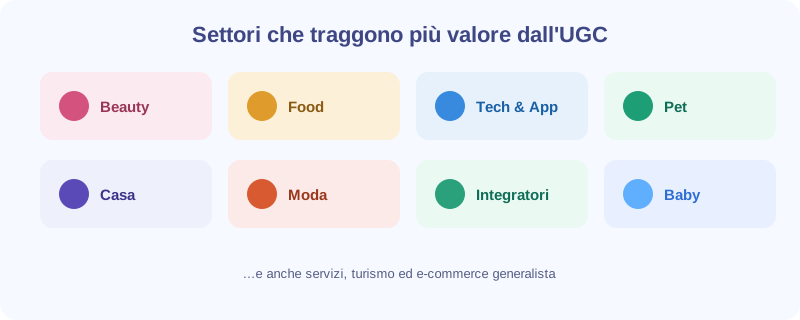
6. Industries that derive the most value from UGC videos
UGC works almost everywhere, but it performs best where trust and demonstration matter most in purchasing decisions. Here are the industries where we see the best results.
- Beauty and skincare: before/after, textures, routines. A sector born for UGC.
- Supplements and wellness: testimonials on results and daily use (with attention to claims).
- Food and beverage: tastings, recipes, consumption, delivery.
- Fashion and accessories: “try-on”, combinations, quality of materials.
- Tech, apps, and electronics: tutorials and function demonstrations.
- Home and furnishings: assembly, real-world use, before/after environments.
- Pet: the product used by the animal, high emotional charge.
- Babies and Moms: Real-life experiences, trust is in high demand.
- Local services, tourism, general e-commerce: Experiences, reviews, “how it went” stories.
If you’d like to see examples and ideas for your category, you’ll find pages dedicated to the different UGC sectors on our website. Explore our UGC services.
Angle that works and hooks by sector
Each category has an “angle” that converts best. This table is a starting point for your brief.
| Sector | Angle that works | Example of hook |
|---|---|---|
| Beauty / skincare | Before/after, texture, routine | “My skin after 14 days: look.” |
| Supplements / Wellness | Typical day, energy, habit | “The thing I’ve added to my morning routine.” |
| Food / Beverage | Time to consume, recipe, flavor | “The snack that saves my afternoon at the office.” |
| Fashion / Accessories | Try-on, combinations, quality | “3 outfits with just one item.” |
| Tech / App | Tutorial, “Wow” feature, before/after | “I do it in 20 seconds instead of half an hour.” |
| Home / Furniture | Easy assembly, before/after environment | “I transformed this corner for 30 euros.” |
| Pet | Animal reaction, emotion | “My dog’s face when he tried this.” |
| Babies / Moms | Real experience, trust | “From mom to mom: this saved my nights.” |
| Services / Venues | “How did it go?” Experience | “I booked without expecting anything. Instead…” |
Why UGC increases trust (and reduces returns)
There’s an advantage of UGC that’s visible downstream, in business numbers: it helps customers buy with the right expectations. A real video shows the product’s dimensions, materials, functionality, and “what it’s really like,” much better than a catalog photo. The result is twofold: on the one hand, more people are convinced to buy (trust), and on the other, buyers know what to expect and are more satisfied—which translates into fewer returns, fewer support requests, and better reviews. This is one of the reasons why a UGC video on the product page performs so well: it improves both conversion and purchase quality.
Which products work best with UGC videos?
UGC works almost everywhere, but some products are “born” for this format. They generally perform better when:
- The result is visible or demonstrable (beauty, cleaning, fitness, home);
- They solve a clear and felt problem (so the hook is easy);
- They have a “use moment” that can be described (food, supplements, lifestyle);
- They are better understood in action than in description (tech, gadgets, tools);
- They have a good margin, so the cost of the content quickly pays for itself.
The more “difficult” products to describe (abstract services, complex B2B, highly technical goods) are not excluded: they just require more creative angles — testimonials, use cases, “a day with…”, simple explanations of a concrete benefit. Here too, the rule remains the same: start from the customer’s problem, not the specifications.
7. Anatomy of a UGC Video That Converts
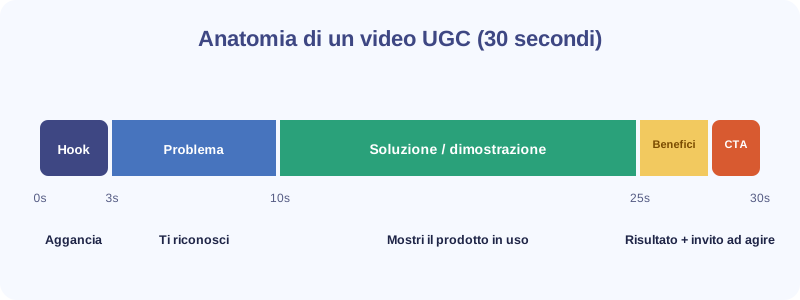
A good UGC video isn’t improvised: it follows a precise structure. This is the backbone that works in the vast majority of cases.
1. Hook (0-3 seconds)
The first 3 seconds decide everything. The hook must capture the audience’s attention: a strong sentence, a recognizable problem, a surprising result, a direct question. Examples: “I wasted money on creams for 2 years, until…”, “If you have oily skin, look at this,” “Nobody tells you this, but…”
2. Problem / Context (3-10 seconds)
Name the viewer’s problem or desire, so that the viewer thinks “he’s talking about me” and stays.
3. Solution and Demonstration (10-40 seconds)
The product enters, shown in real use. This is the part where you see, touch, and apply it. Demonstration is worth more than a thousand adjectives.
4. Benefits and Test (variable)
Explain what changes: the result, the sensation, the concrete advantage. The benefits (“skin stays hydrated all day”) are better than the technical features.
5. Call to action (last seconds)
A clear invitation: “Try it,” “Link in bio,” “Take advantage of the discount.” Without a CTA, even the best video leaves the viewer without the next step.
The script: better guided or free?
The two approaches work in different contexts:
- Guided script: You provide the script (hook + key points + CTA). Maximum control of the message, useful for sensitive claims and advertising tests.
- Free Brief: only provide the objectives and key points, leaving the creator to speak for themselves. Maximum authenticity and often more “real” hooks.
A good practice is the mix: hooks and CTAs driven by you (these are the most important points), the body of the video left to the creator’s discretion.
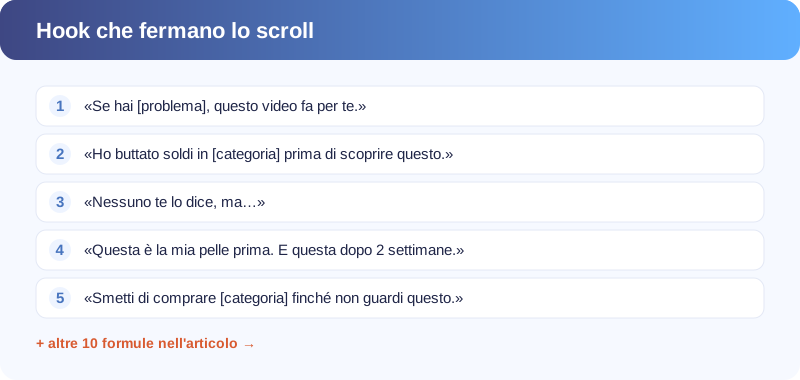
15 Hook Formulas That Stop Scrolling
The hook is the lever with the greatest impact on the result. Here is a set of proven “schemes”: think of them as templates to fill with your product. In advertising, it’s best to shoot 3-4 versions and let the data decide the winner.
- Direct problem: “If you have [problem], this video is for you.”
- Common mistake: “You’re using [category] wrong. Here’s why.”
- Surprising result: “I didn’t believe it until I saw it with my own eyes.”
- Before/After: “This is my skin before. And this after 2 weeks.”
- Confession: “I wasted [X] € in [category] before I discovered this.”
- Secret/curiosity: “Nobody tells you this, but…”
- Direct question: “Why isn’t anyone talking about [benefit]?”
- Against the grain: “Stop buying [category] until you look at this.”
- Quicklist: «3 reasons why I changed .»
- For a specific target: «If you’re over 30, this will interest you.»
- Urgency/New: «It just came out and it’s already my favorite.»
- Objection overturned: “I thought it was yet another scam. I was wrong.”
- Immediate demonstration: (show the result in the first 2 seconds without saying anything).
- Past comparison: “I used [old method] for 10 years. Never again.”
- Storytelling: “It all started when…”
Example Full Script (30-Second Video)
Here’s how the structure translates into a concrete script. Example for a face cream (adapt to your product):
[3-9s — PROBLEM] “I had dry, tight skin, especially in the winter. I’ve tried everything, but nothing has really worked.»
[9-22s — SOLUTION/DEMO] (apply the product) «You only need a little, it absorbs quickly and isn’t greasy at all. I apply it in the morning under my makeup and at night before bed.»
[22-27s — BENEFIT/TRIAL] «After two weeks, my skin is soft and hydrated all day long. Look at the difference.» (show the result)
[27-30s — CTA] «If you have dry skin, try it: you’ll find the link below.»
Note how the hook names a real pain and a turnover. The product only appears after hooking the viewer, and the CTA is specific. For ads, run 2-3 versions of the hook, keeping everything else identical: often, everything changes only there.
How to write an effective CTA
The call to action is the bridge between “I liked it” and “I’ll buy it.” Quick rules:
- One action: Don’t ask for three things at once. One clear CTA.
- Verb + benefit: “Try it and say goodbye to dry skin” beats “click here.”
- Reduce friction: “link below”, “in 2 minutes”, “no obligation”.
- Add a reason to act now: offer, limited stock, news (if true).
- Consistency with the destination: the page they land on must deliver on the promise of the video.
8. Who is the UGC creator (and why they are not influencers)
The creator UGC is a professional who produces authentic-looking videos for brands. The fundamental difference between an influencer and an influencer is one, but crucial:
This has important practical consequences:
- You can work with “small” creators or those without an audience, choosing them based on their face, tone, and ability to shoot, not their followers;
- The costs are much lower than those of established influencers;
- The content is yours: you use it in ads and wherever you need it (according to the agreed rights);
- You can build a recurring creator park and produce content continuously.
What does a UGC creator actually do?
- Reads the brief and understands the objective, target audience, and key messages;
- Writes or adapts the script and prepares the shot;
- Shoot the video with your smartphone (sometimes multiple variations of the hook);
- Edit, add subtitles, on-screen text, and any music;
- Deliver the finished file, in the requested formats, with any revisions.
Types of UGC Creators
There’s no single profile. Recognizing them helps you assemble the right “cast”:
- The “relatable” face: the everyday person the audience can identify with. Perfect for testimonials and problem-solving.
- The niche expert/enthusiast: has in-depth knowledge of the category (skincare, fitness, tech). Excellent for tutorials and content that requires credibility.
- The performer: is comfortable on camera, energetic, and good with trends. Ideal for TikTok and dynamic hooks.
- The product demonstrator: has precise hands and the ability to showcase the product well. Indispensable for demonstrations and ASMR.
For the best campaigns, different profiles are mixed: age, gender, tone. It’s the variety of faces that allows you to reach different segments of the same audience.
Do you need UGC videos for your brand?
With UGC House, you receive videos made by selected creators, tailored to your products and ready for your ads — with a guided brief, clear price ranges, and usage rights included.
9. How to find and choose UGC creators
There are three main ways to source UGC videos, each with different pros and cons.
| Channel | Pros | Cons |
|---|---|---|
| UGC Platforms/Agencies | Selected creators, managed brief, quality and time guaranteed, rights included | Slightly higher cost than DIY |
| Freelance (marketplace, social) | Potentially low price | Selection, quality, and management are your responsibility; Inconsistent results |
| Real customers / community | Maximum authenticity, low cost | Little control, variable technical quality, slow |
For most companies that want consistency and quality without becoming a casting director, the most efficient way is to rely on a platform that selects creators and manages the workflow (brief → production → review → delivery).
How to evaluate a UGC creator
- Portfolio: watches pre-made videos. What matters is the quality of the voice, lighting, and editing, not the number of followers.
- Hook-ability:Does know how to grab attention in the first few seconds?
- Target Affinity: Are the face and tone of the consistent with your typical customer?
- Reliability: Does meet deadlines and briefs? Does it handle revisions well?
- Versatility: Does handle different formats (review, tutorial, problem-solving)?
Warning signs
Signs that can save you time and unpleasant surprises:
- Portfolio that’s only “nice to look at” but lacks the ability to sell;
- Poor audio or terrible lighting (minimum technical quality matters);
- Slow or vague responses already at the agreement stage: often anticipate delivery problems;
- Unwilling to make variations of the hook or minor revisions;
- Confusion about usage rights: it must be clear from the outset that you can use them in advertising.
How to Get UGC Videos from Real Customers (Organic UGC)
Alongside commissioned videos, it’s also worth encouraging spontaneous UGC from customers: it’s inexpensive and adds authentic social proof. How to encourage it:
- Explicitly ask: After purchase, invite people via email or a note in the package to share a video tagging the brand.
- Create a memorable branded hashtag and display it everywhere.
- Make sharing easy: explain in 1 line what to show (e.g., “show me how you use it”).
- Incentive: contest, discount on your next order, chance to be reshared by the brand.
- Reshare the best: Showing that you republish customer content encourages others to participate.
- Always ask permission before reusing someone else’s content, especially in advertising.
10. The perfect brief for a UGC video
The brief is the document that makes the difference between a useful video and one that needs remaking. A good brief is clear, concise, and gives the creator everything they need without suppressing their naturalness.
What to always include
- Product and link: what it is, how it works, where to buy it.
- Video objective: Is for ads? For the feed? For the product page?
- Target: who we are talking to (age, problem, desire).
- Format and Length: 9:16, 15-30 seconds, etc.
- Video Type: review, unboxing, troubleshooting…
- Requested Hook (or Examples): The most important point; better to give 1-2 to try.
- Key points to cover: 2-4 benefits or messages, in order of priority.
- What NOT to say: Prohibited claims, words to avoid, and unacceptable promises.
- Final CTA: The exact action phrase.
- References: 1-2 video examples of the desired style.
- Technical specifications: with/without subtitles, with/without music, hook variations.
Brief template (copy and paste)
Here is a ready-to-fill template: just a few lines per field.
• Product: [name + 1 line about what it does]
• Product link: [url]
• Target: [Ads Meta / TikTok / Product Listing / Organic]
• Target: [Who is he, what’s his problem?]
• Format: 9:16 vertical · duration 20-30 sec
• Video Type: [review / problem-solve / tutorial…]
• Hooks to Try (1-2): [opening quote]
• Key Points (max 3): [benefit 1, 2, 3]
• Do Not Say: [Prohibited Claims / Words to Avoid]
• Final CTA: [Exact Action Phrase]
• Reference Style: [1-2 Example Video Links]
• Deliveries: subtitles yes/no · music yes/no · n. hook variants · extra formats
If you need a starting point, with UGC House the brief is guided: we ask you the right questions step by step, so the creator gets everything they need and you don’t start from scratch.
How to give good feedback during the review phase
A good review improves the video; a bad one ruins it and wastes both of your time. Helpful rules:
- Be specific: “the hook is weak” doesn’t help. Better: “in the first 3 seconds, add sentence X before showing the product.”
- Refer to the seconds: indicates the timecode (“at sec 8 the product is difficult to see”).
- Distinguish “mandatory” from “preference”: Not everything has the same weight.
- Don’t rewrite everything: If you restrict the creator too much, you lose the very authenticity you were looking for.
- Agree on review rounds: usually includes 1-2 rounds; more than that must be agreed upon.
- Enhance what works: Determining what to keep is as important as determining what to change.
11. How much do UGC videos cost?
It’s the most frequently asked question, and the honest answer is: “It depends.” But we can give you realistic ranges and the factors that influence the price.
Price Determining Factors
- Length and Number of Videos: (a multi-video package costs less per video);
- Creator Level: (standard vs. more experienced/premium creators);
- Complexity: (more scenes, more editing, product intended for extended use);
- Extras: hook variations, subtitles, voiceover, music, additional photos;
- Usage Rights: (organic only vs. advertising and whitelisting);
- Urgency: (expedited delivery costs more);
- Shipping product to the creator.
Indicative market ranges (Italy)
| Type | Indicative price per video |
|---|---|
| Basic UGC video (standard creator, 15-30 seconds) | ~ €60-120 |
| Premium UGC video (expert creator, carefully edited) | ~ €120-220 |
| Multiple packages (multiple videos together) | Lowest price per video |
| Extras (additional hooks, subtitles, voice, (photo) | from ~ €19-49 each |
These are indicative market values, useful for orientation. The actual price depends on the project.
Are UGC videos expensive?
Compared to a production spot (easily thousands of euros) or an established influencer, UGC is one of the most affordable and scalable forms of video. The right question isn’t “how much does a video cost,” but “how much does a conversion cost me”: if four videos costing a few hundred euros generate sales at a sustainable CPA, their “cost” is actually an investment that pays off.
DIY or platform?
Producing in-house seems free, but it has hidden costs: time spent searching for and selecting creators, managing briefs and reviews, contracts and rights, inconsistent quality, and no guarantee on time. A platform “packages” all of this: selection, guided briefing, reviews, rights, and delivery. For those who want continuity—and not a single, one-off video—it’s almost always more cost-effective in terms of time and energy.
| Do-it-yourself | UGC platform | |
|---|---|---|
| «Showcase» price | Lower | Transparent, slightly higher |
| Time required by you | High | Minimum |
| Quality Guaranteed | Variable | Yes (validated creators) |
| Rights and Contracts | Paid for your | Included/Managed |
| Scalability | Low | High |
At UGC House, you’ll find transparent price ranges for (standard and premium) and packages, with optional extras and usage rights included: you can view the quote in real time from the configurator [internal link: page /order-video/].
12. How to Measure the Results of UGC Videos
“It works” isn’t a given. Here are the metrics that really matter, broken down by objective.
Attention Metrics (Does the Video Hook?)
- Hook Rate (3-Second Views / Impressions): Measures whether the open rate is working;
- Hold / Retention: How long the video is watched;
- Thumbstop ratio: how many people stop.
Action metrics (does the video sell?)
- CTR (click-through rate): how many people click;
- CPA / cost per acquisition: how much a conversion costs you;
- ROAS (return on ad spend);
- Conversion rate of the page they land on.
How many videos do I need to get started?
For a serious initial test, you need at least 3-5 different videos (faces, hooks, and different angles). With just one video, you can’t tell if “the product doesn’t work” or “that creative doesn’t work.” The more variables you test, the faster you’ll find the winner.
| Phase | How many videos | Objective |
|---|---|---|
| First test | 3-5 | Find 1-2 winners |
| Scaling | +3-4 per month | Winner variations + new angles |
| Regime | 4-8 per month | Replenish “fresh” creatives before they tired |
How to plan a month of UGC
- Week 1: brief and produce 4-5 videos with different angles.
- Week 2: test launch, equal budget for each creative.
- Week 3: analysis (hook rate, CTR, CPA), shut down the losers.
- Week 4: produce variations of the winners and new angles to test the following month.
This cycle, repeated over time, builds a library of winning creatives and a system that improves on its own.
Reference Benchmarks (Guidelines)
The “good” values vary by industry and platform, but as a guide:
- Hook rate (view at 3 seconds): the higher, the better — it’s the first signal to look for;
- Hold/retention: aims to keep the viewer for more than half the video;
- CTR: Compare it to your account average, not to abstract numbers;
- CPA/ROAS: These are the final judges. A video with lots of views but no sales is not a good video.
An example of ROI (with numbers)
Let’s do a simple and illustrative calculation to understand the reasoning. Imagine ordering 5 videos UGC at an average of €120 each: €600 worth of content.
- You use them for advertising, each with the same testing budget;
- Three videos disappoint and you turn them off; 2 work;
- Focus your spending on the winner: let’s say €2,000 invested with a ROAS of 3 → €6,000 in sales generated;
- The €600 in content is 10% of the advertising spend and pays for itself many times over.
The point isn’t the exact numbers (they vary for every business), but the logic: produce more creative content at a low cost; just one or two “winning” pieces are enough to more than recoup the entire video investment. That’s why it’s best to think in terms of video packages and not individual pieces: you increase the chances of finding a winner and reduce the risk.
13. Usage rights, contracts, and regulations
Often overlooked, this is a crucial point: using content without the right rights can be costly.
- Usage Rights: Determine how long and on which channels you can use the video. Advertising requires appropriate rights: make sure it’s clear.
- Whitelisting / Spark Ads: Promote the video from the creator’s account (on Meta or TikTok) for more authenticity. Requires specific permission.
- Exclusive: If you don’t want the creator to work with competitors, this must be agreed upon (and usually costs more).
- Image Release: The creator authorizes the use of their face and voice.
- Advertising Transparency: Sponsored content must be marked as such, according to the platform’s rules and advertising regulations.
- Claims and sensitive sectors: Supplements, health, beauty, and finance have strict rules about what can be promised. Define in the brief what NOT to say.
Other aspects not to forget
- Privacy and GDPR: If identifiable people appear in the video (in addition to the creator), their consent to the processing and use of the image is required.
- Minors: If children appear, parental/guardian permission and special caution are required; many platforms have additional rules.
- Music and Audio: Trending songs available on social media apps are often not eligible for paid ads due to licensing reasons. Use commercially licensed music or dedicated audio libraries for ads.
- Third-party brands and products: Be careful not to display logos or products from other brands without authorization.
- Verifiable claims: Every claim (“eliminates,” “cure,” “in 7 days”) must be substantiated; in the health/beauty sectors, the rules are stringent.
14. Common Mistakes to Avoid
- Weak Hook: The first 3 seconds are anonymous = dead video.
- Start with the product instead of the viewer’s problem.
- Look like a commercial: Too perfect, too much “advertising” = loses authenticity.
- Un video only: Without variants, you cannot test or scale.
- Vague brief or, conversely, cage the creator word for word.
- No CTA: the viewer doesn’t know what to do next.
- Forget subtitles: most users watch without sound.
- Ignoring usage rights and then not being able to use the video in ads.
- Not measuring:Without data, you don’t know what to replicate.
- Giving up after the first test: UGC is an iterative process, not a one-shot.
The common thread running through all these mistakes is one: treating UGC as content “to be published” rather than a system to run. Those who fail produce a video, launch it, and wait. Those who succeed produce more variations, measure, learn, and double down on what works. The difference in results, in just a few months, is enormous.
15. How to Become a UGC Creator
If you’re on the other side of the fence—wanting to make money by creating UGC videos—the good news is that you don’t need a large following or expensive equipment. You just need to know how to shoot content that sells.
What you really need
- A smartphone with a good camera and a light (even just a natural one or an inexpensive ring light);
- The ability to speak naturally into the camera;
- Editing Basics (free apps like CapCut are enough to get started);
- A portfolio: 3-5 example videos, including ones featuring your own products.
Getting Started
- Study the hooks that work in your niche;
- Create a mini-portfolio with different formats;
- Sign up for platforms that connect creators and brands;
- Be reliable and adhere to briefs: that’s what keeps clients coming back.
How much do you earn as a UGC creator?
Compensation depends on experience, quality, and project type. Initially, it starts with low amounts per video; as you grow your portfolio, reliability, and ability to sell, the value per video increases and recurring collaborations arrive—which are the true source of stable income. Extras (hook variations, voiceovers, additional edits, broader usage rights) increase your compensation for the same amount of footage.
How to set your price
- Start from the market:observe the typical tiers (basic and premium) and honestly position yourself according to your level;
- Package:offer “1 video”, “3 videos”, “monthly package” – customers are more likely to buy a single course;
- Charge for extras: additional hooks, subtitles, cross-platform versions, advertising rights;
- Evaluate rights: advertising use and exclusivity are worth more than just organic;
- Grow with value: When your video “scales” in advertising for a client, you have concrete proof to raise your rates.
Want to become a UGC creator?
Apply as a creator on UGC House: receive work from real brands, with clear briefs and transparent compensation.
16. Trends and Future of UGC Videos (2026)
- UGC + Artificial Intelligence: AI tools for hook variations, subtitles, dubbing, and localization in multiple languages, keeping the human creator at the center.
- Hyper-volume and creative testing: brands produce dozens of variations to find winners faster.
- “Niche” creator: consistency with a specific target audience, not popularity, matters more and more.
- UGC beyond social media: increasingly present on product pages, emails, retail, and even CTV.
- “Defending” Authenticity: As AI grows, genuinely human content becomes a distinctive value.
Other directions to watch:
- Social commerce: Purchases are increasingly taking place within social media (TikTok Shop, Instagram stores); UGC video becomes the showcase that converts on-site.
- UGC on CTV and beyond the smartphone: authentic content arrives on connected TV and marketplaces, where trust matters as much as on social media.
- Ongoing relationships with creators: less “one-off videos,” more recurring collaborations that build consistency and trust over time.
- Long-form UGC: Alongside the 15-second format, longer formats (in-depth reviews, “day in the life”) are growing for audiences in the evaluation phase.
- More mature measurement: Better tools for understanding which creative drives sales, not just views.
17. Examples and mini case studies
Three typical (illustrative) scenarios to understand how all this applies.
The process: from brief to delivery
For those starting from scratch, here’s what a well-managed UGC video project looks like in practice—the same steps you’ll find on a platform like UGC House.
- Order configuration: Choose the number of videos, tier (standard/premium), length, format, and any extras (additional hooks, subtitles, photos, etc.). See the transparent price.
- Guided Brief: answer a few targeted questions (objective, target audience, messages, what not to say). No blank slate.
- Creator Selection: will suggest suitable profiles, or you can choose from the candidates.
- Shipping of the product (if applicable) to the creator, with tracking.
- Production: The creator shoots and edits according to the brief, including the requested variations.
- Revision: Receive the draft, give feedback, and obtain the agreed-upon corrections.
- Delivery: Download the final files in the requested formats, with the usage rights in place.
How to Integrate UGC Videos into Your Strategy
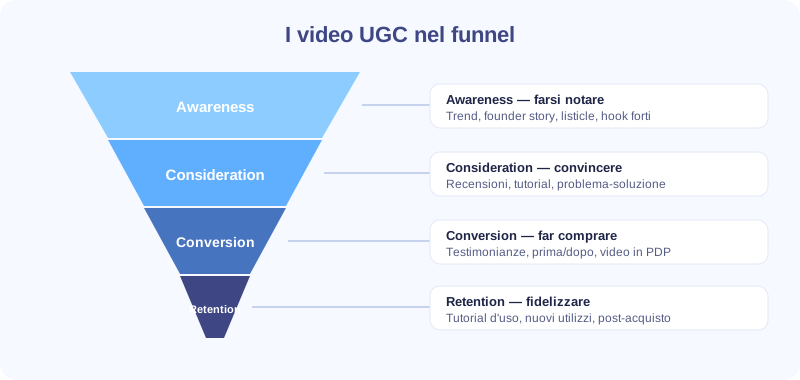
UGC videos are at their best when they’re not a one-off initiative, but a part of the funnel. Here’s how to distribute them along the customer journey.
| Funnel stage | Objective | Type of UGC |
|---|---|---|
| Awareness (discovery) | Get noticed | Trend, founder story, listicle, strong hooks |
| Consideration (evaluation) | Convince | Reviews, tutorials, problem-solving, comparisons |
| Conversion (purchase) | Drive to action | Testimonials, before/afters, offers, PDP videos |
| Retention (loyalty) | Far Return | User tutorials, new uses, post-purchase content |
A common mistake is using the same video everywhere. Those who don’t know you need a hook; those who are evaluating you want proof and demonstrations; those who are ready to buy want a final push. Think of UGC as a content system, not a single video.
Checklist: Your first UGC video in 7 steps
- Define the objective (ads, product listing, organic) and the metrics that matter.
- Choose the right format for your goal (problem-solution, review, tutorial, etc.).
- Write a one-page brief, with a hook and “what not to say.”
- Select 3-5 creators with different faces and tone.
- Request variations of the hook : this is the lever with the most impact.
- Launch a test with the same budget for each creative.
- Measure, shut down the losers, scale the winners and create variations of the best.
18. Getting Started with UGC House
In summary: UGC videos are now the most efficient way to create authentic content that sells, on social media and beyond. The process is simple—define the goal, write a good brief, choose the right creators, test multiple variations, and measure the results.
With UGC House, you can do it hassle-free: , guided briefing, , , selected creators, , , clear price ranges, , , rights included, , and end-to-end managed delivery.
Whether you’re just starting out or want to industrialize content production, the principle remains the same: authenticity is the most effective language for selling online today, and UGC videos are the fastest and most cost-effective way to communicate it. You don’t need a huge budget or a creative department: you just need to start, test, and improve. Brands that do this methodically build an advantage over time that’s hard to regain—a library of content that sells, and a system that continually generates new content.
Ready to receive your UGC videos?
Configure your order in minutes and receive videos ready for your campaigns.
UGC Terms Glossary
The terms you’ll most often encounter when working with UGC videos, explained simply.
- UGC (User Generated Content)
- User-generated content. In marketing, it refers to authentic-looking videos and photos created by real people, often commissioned by brands.
- UGC Creator
- A professional who produces UGC content for brands. They sell the content, not the audience: followers aren’t needed.
- Hook
- The opening of the video (first 1-3 seconds), the part that “stops the scroll.” It’s the element with the most impact on the result.
- CTA (Call to Action)
- The final call to action: “Try it,” “Link in bio,” “Take advantage of the offer.”
- Brief
- The document in which the brand explains the video’s objective, target audience, messaging, and rules to the creator.
- B-roll
- Supporting footage (product details, hands, environment) used to enhance and edit the video.
- Usage rights
- How long and on which channels the brand can use the content, including advertising.
- Whitelisting / Spark Ads
- Sponsor content directly from the creator’s account (Meta = partnership/whitelisting, TikTok = Spark Ads) for greater authenticity.
- Hook rate
- Percentage of people who watch at least the first 3 seconds: measures how much the opening “engages.”
- Retention / hold
- How long the video is watched: indicates whether the content maintains attention.
- CPA / ROAS
- Cost per acquisition and return on ad spend: the final judges of a campaign.
- Creative testing
- The process of testing multiple creatives to find and scale the winners.
- PDP (Product Detail Page)
- The product page: one of the places where a UGC video increases conversions.
- Raw footage
- Raw, unedited footage; sometimes requested by brands for their own editing.
Frequently Asked Questions about UGC Videos
- What does UGC mean?
- UGC stands for User Generated Content. A UGC video is authentic-looking content, shot by a real person, showcasing or reviewing a product.
- What is the difference between a UGC creator and an influencer?
- The influencer sells access to their audience and publishes on their channels. The UGC creator sells the content: the brand uses the videos on its channels and in ads. You don’t need followers to create UGC.
- How much does a UGC video cost?
- In Italy, it typically ranges from around €60-120 for a basic video to €120-220 for a premium video, with lower prices per video in multiple packages. The cost depends on the length, creator level, extras, and usage rights.
- How long is a UGC video?
- Generally between 15 and 60 seconds, in a 9:16 vertical format. For ads, the most effective ones are often between 15 and 30 seconds.
- Can I use UGC videos in paid ads?
- Yes, that’s the primary use. Make sure you have advertising usage rights and, if you want to advertise from the creator’s account, whitelisting/Spark Ads permission.
- Do I need a lot of followers to make UGC videos?
- No. UGC creators are chosen based on the quality of their content, their face, and their tone, not their number of followers.
- What equipment do I need to shoot UGC videos?
- All you need is a smartphone with a good camera, good lighting (even natural lighting), and a free editing app like CapCut. The ability to speak into the camera and craft a good hook are more important.
- How long does it take to receive videos?
- It depends on the project and the creator’s availability; Typically, a few days to a couple of weeks, including any product shipping and review times.
- Do UGC videos work for my industry?
- Almost always. They perform best where trust and demonstration matter most: beauty, supplements, food, fashion, tech, home, pets, and baby. But services and general e-commerce also benefit from them.
- Is a guided script better than leaving the creator free?
- Often, a mix is the best choice: you guide the hook and CTA (the points that matter most), and the body of the video is left to the creator’s discretion.
- How many UGC videos do I need to get started?
- For a serious initial test, at least 3-5 different videos, with different faces and hooks. You can’t tell what really works with just one video.
- Do UGC videos work without an advertising budget?
- Yes: in addition to ads, they’re excellent for organic content, product pages, emails, and websites. But they really shine in advertising, because you can test them and scale them.
- Do I have to send the product to the creator?
- For many formats (reviews, unboxings, tutorials), yes, because the product must be shown in real use. In some cases, you can work with materials and images provided by the brand.
- Can I use the same video on TikTok and Instagram?
- Yes, but it’s often worth adapting (opening, pace, audio): TikTok favors a more raw and native style, while Meta favors a slightly more polished one.
- What makes a UGC video truly effective?
- A strong hook in the first 3 seconds, a recognizable problem, a real-world product demonstration, and a clear call to action. And, in advertising, the ability to test different variations.
- Will UGC videos be replaced by artificial intelligence?
- AI is entering the flow (variants, subtitles, translations), but the distinguishing value of UGC is precisely its human authenticity. The most effective model today is “human creator + AI as an accelerator.”


